


 contact us
2026/02/09
利統股份有限公司 技術部保健品配方組 楊宗翰 博士
憂鬱症已成為影響現代人生活品質的主要疾病之一。根據世界衛生組織(WHO)近年的數據換算1,全世界約有4% 人口患有憂鬱症,等於全球約有 3 億人以上受其困擾;且依據台灣中央健保署的資訊顯示,2021年全台被診斷為憂鬱症的人數將近64萬人,十年來成長了24.4% 2,這表示憂鬱症在台灣也是迫切需要重視及解決的病症。
從生理的角度來看,憂鬱症可能與單胺類神經傳導物質: 血清素(Serotonin)、正腎上腺素(Norepinephrine)的缺乏有關3。此外,近期有期刊指出「神經發炎 (Neuroinflammation)」與「氧化壓力 (Oxidative stress)」也是引起憂鬱症的關鍵的危險因子4。
當人體長期處於高壓環境,大腦中的微膠質細胞 (Microglia) 會被過度活化,釋放促炎細胞因子 (如 IL-6, TNF-α),這不僅會干擾血清素的訊號傳導,還會導致神經元的損傷5。
目前市面上常見的紓壓保健素材,主要是以增加血清素前驅物或促進血清素的合成,以增加血清素作為抗憂鬱的機制,然而這可能無法有效的改善因神經發炎或氧化壓力造成的憂鬱機制。
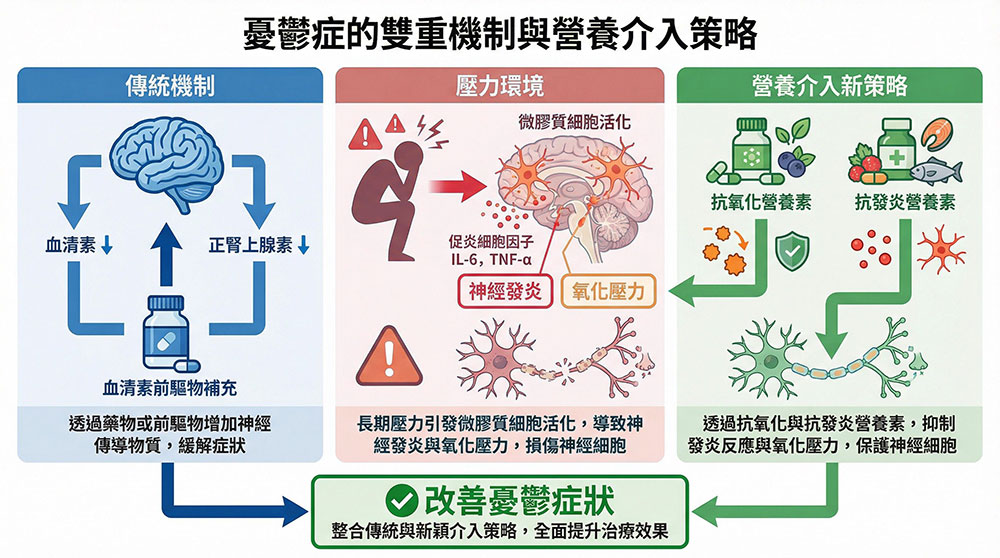
針對導致氧化壓力與發炎造成的憂鬱,目前有兩種潛力素材:藏紅花(Saffron)與咪唑二肽(Imidazole dipeptides),可從不同的角度達到抗憂鬱及神經保護的效果。
藏紅花 (Saffron) (學名: Crocus sativus L.),又被稱番紅花、西紅花,是鳶尾科植物的乾燥雌蕊柱頭。藏紅花萃取物已在許多人體臨床試驗上被證明具有改善憂鬱的能力6,可能的機制如下:
抑制神經傳導物質的再攝取 (Reuptake)
神經突觸間的神經傳導物質濃度降低,被認為是造成憂鬱及多種神經退化疾病的主因7。以血清素為例,當處在氧化壓力的環境下,可能會增加血清素轉運蛋白 (SERT, Serotonin transporters) 的表達8,增加血清素被SERT回收,使神經突觸間的血清素濃度降低,進而產生憂鬱的情緒。藏紅花中的兩種活性成分 Crocin 與 Safranal,能分別抑制血清素 (Serotonin) 與正腎上腺素 (Norepinephrine) 這兩種神經傳導物質被轉運蛋白回收,提升神經突觸間神經傳導物質的濃度 9,這樣的機制,類似目前主流的抗憂鬱藥物:如 SSRI (Selective serotonin reuptake inhibitor) 及SNRI (Serotonin-Norepinephrine reuptake inhibitors),因此能夠有效降低憂鬱感穩定情緒。
保護神經細胞
藏紅花萃取物亦可在神經細胞受到氧化壓力時,透過提升腦源性神經營養因子 (BDNF) 的濃度8,降低氧化損傷保護神經細胞。
咪唑二肽 (Imidazole dipeptide) 包含了「肌肽 (Carnosine)」與「甲肌肽(Anserine)」,主要存在鳥類與魚類的肌肉中。咪唑二肽除了具有抗疲勞效果外10,也是具有改善神經退化與憂鬱症潛力的素材 11。由Tomonaga 等人 (2008) 的動物試驗可發現12,給大鼠服用富含咪唑二肽的雞胸肉萃取物及肌肽,可展現出類似抗憂鬱 (Antidepressant-like activity)的效果。而咪唑二肽可能透過以下機制,來達到抗憂鬱的潛力:
降低氧化壓力造成的傷害
咪唑二肽中的肌肽 (Carnosine) ,被視為天然的「醛類清除劑 (Aldehyde Scavenger)」13,也具有金屬離子(例如鋅和銅)螯合劑的能力14,這些特性能降低氧化壓力,並減少脂質過氧化物及糖化終產物 (AGEs, Advanced glycation end products) 15。
降低並調節神經發炎
肌肽是一種具有抗發炎效果的原料,已被證實可降低發炎因子的釋放16。在Herculano等人的研究中發現17,補充肌肽可改善高脂飲食下的阿茲海默症基因轉殖小鼠的腦部發炎及腦血管異常。因此,咪唑二肽的抗發炎特性,有助於降低神經發炎,進而產生保護神經細胞的效果。
藏紅花與咪唑二肽在抗憂鬱的可能機制上各具優勢。藏紅花擁有較完整的動物及臨床數據,且有著類似抗憂鬱藥物機制的優勢,可調節神經傳導物質來改善憂鬱。而咪唑二肽則是可以從降低氧化壓力及改善神經發炎的方向來減少神經損傷,有助於緩解神經損傷造成的神經退化及憂鬱的現象,此外,咪唑二肽的抗疲勞效果,亦有助於舒緩因疲勞造成的低落情緒,很適合在高壓環境下容易疲勞及憂鬱的上班族群。
World Health Organization. (2025). Depressive disorder (depression)。https://www.who.int/news-room/fact-sheets/detail/depression
社團法人台灣憂鬱症防治協會: 各年齡層憂鬱症的求助阻礙。葉雅馨。https://www.depression.org.tw/communication/info.asp?/167.html
Hamon, M., & Blier, P. (2013). Monoamine neurocircuitry in depression and strategies for new treatments. Progress in Neuro-Psychopharmacology and Biological Psychiatry, 45, 54-63.
Correia, A. S., Cardoso, A., & Vale, N. (2023). Oxidative stress in depression: the link with the stress response, neuroinflammation, serotonin, neurogenesis and synaptic plasticity. Antioxidants, 12(2), 470.
Zheng, Y., & Xu, L. (2025). Bidirectional crosstalk between microglia and serotonin signaling in neuroinflammation and CNS disorders. Frontiers in Immunology, 16, 1646740.
Kehtari, T., Tovar, D. C., Epstein, D., & Junquera, P. (2025). From Mood to Memory: Unlocking Saffron’s Potential in Brain Health. Cureus, 17(4).
Werner, F. M., & Covenas, R. (2010). Classical neurotransmitters and neuropeptides involved in major depression: a review. International Journal of Neuroscience, 120(7), 455-470.
Wauquier, F., Boutin-Wittrant, L., Pourtau, L., Gaudout, D., Moras, B., Vignault, A., ... & Wittrant, Y. (2022). Circulating human serum metabolites derived from the intake of a Saffron Extract (Safr’InsideTM) protect neurons from oxidative stress: consideration for Depressive Disorders. Nutrients, 14(7), 1511.
Chauhan, S., Tiwari, A., Verma, A., Padhan, P. K., Verma, S., & Gupta, P. C. (2024). Exploring the potential of saffron as a therapeutic agent in depression treatment: a comparative review. The Yale Journal of Biology and Medicine, 97(3), 365.
Nishitani, M., Munekiyo, Y., Sugino, T., & Kajimoto, O. (2009). Novel anti-fatigue compound: Imidazole dipeptide. Japanese Journal of Complementary and Alternative Medicine, 123-129.
A Babizhayev, M. (2014). Biochemical, biomedical and metabolic aspects of imidazole-containing dipeptides with the inherent complexity to neurodegenerative diseases and various states of mental well-being: A challenging correction and neurotherapeutic pharmaceutical biotechnology for treating cognitive deficits, depression and intellectual disabilities. Current pharmaceutical biotechnology, 15(8), 738-778.
Tomonaga, S., Yamane, H., Onitsuka, S., Yamada, S., Sato, M., & Furuse, M. (2008). Carnosine-induced antidepressant-like activity in rats. Pharmacology Biochemistry and Behavior, 89(4), 627-632.
Guiotto, A., Calderan, A., Ruzza, P., & Borin, G. (2005). Carnosine and carnosine-related antioxidants: a review. Current medicinal chemistry, 12(20), 2293-2315.
Reddy, V. P., Garrett, M. R., Perry, G., & Smith, M. A. (2005). Carnosine: a versatile antioxidant and antiglycating agent. Science of Aging Knowledge Environment, 2005(18), pe12-pe12.
Boldyrev, A. A., Aldini, G., & Derave, W. (2013). Physiology and pathophysiology of carnosine. Physiological reviews.
Son, D. O., Satsu, H., Kiso, Y., Totsuka, M., & Shimizu, M. (2008). Inhibitory effect of carnosine on interleukin-8 production in intestinal epithelial cells through translational regulation. Cytokine, 42(2), 265-276.
Herculano, B., Tamura, M., Ohba, A., Shimatani, M., Kutsuna, N., & Hisatsune, T. (2013). β-alanyl-L-histidine rescues cognitive deficits caused by feeding a high fat diet in a transgenic mouse model of Alzheimer's disease. Journal of Alzheimer’s Disease, 33(4), 983-997.